
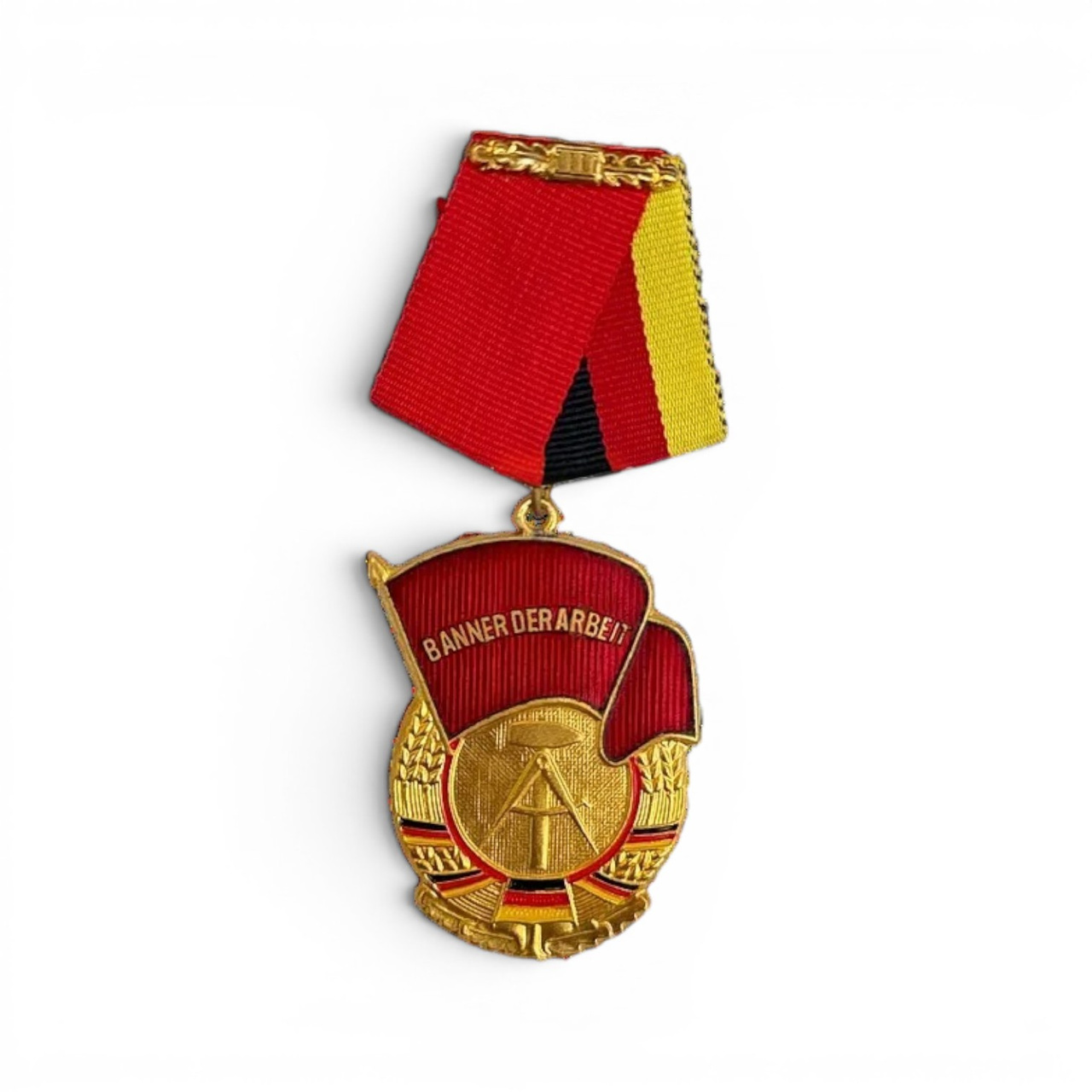

Vintage Commemorative Medal - Order of the Banner of Labour - Class III - Banner der Arbeit III Class - Gold Finish - German Democratic Republic (GDR / NVA) Military Surplus - Good Condition
- The Order of the Banner of Labour - Class III (Banner der Arbeit, III Class) was one of the highest state decorations of the German Democratic Republic (GDR). It symbolized the ideals of socialist labor and recognized outstanding achievements
Subscription products in your basket
Set one delivery frequency for all subscription products in your basket, every:
Subscription products in your basket
The Order of the Banner of Labour - Class III (Banner der Arbeit, III Class) was one of the highest state decorations of the German Democratic Republic (GDR). It symbolized the ideals of socialist labor and recognized outstanding achievements in the development of the economy and society.
Specifications
- Material: gold-plated, enameled non-ferrous metal.
- Reverse: smooth finish.
- Dimensions: approximately 52 × 36 mm (variants measuring 44 × 37 mm also exist, depending on the manufacturer and production period).
- Complete with suspension ribbon.
- Barthel catalog number: 8h.
Description
The Order of the Banner of Labour was established on 4 August 1954 as a single-class state decoration, inspired by the Soviet Order of the Red Banner of Labour.
Originally, the order consisted of only one class. About twenty years later, it was reorganized into a three-class system, with all previously awarded decorations being redesignated as Class I.
The example offered here is Class III, the entry-level class of the order.
The badge is shaped as the coat of arms of the German Democratic Republic, depicting a hammer and compass surrounded by a wreath of wheat ears. Above the emblem is a red enameled banner bearing the raised inscription:
"BANNER DER ARBEIT"
("Banner of Labour")
The decoration was worn on the left side of the chest, suspended from a pentagonal ribbon in the national colors of the GDR (red, black, and gold). At the top of the ribbon is a golden oak branch featuring the Roman numeral "III", indicating the class of the order.
Both smooth and textured reverse versions exist. This example has a smooth reverse.
Award Criteria
The order was awarded for:
- exceptional and long-term achievements in strengthening the German Democratic Republic;
- outstanding contributions to the development of the national economy;
- exceptional accomplishments within the socialist competition movement;
- exemplary initiatives and achievements in the field of labor.
The decoration could be awarded to:
- individuals;
- work collectives;
- enterprises;
- industrial combines;
- state institutions.
In certain cases, it could also be awarded to foreign citizens.
Recipients were generally expected to have previously received other state decorations of the GDR.
Award Ceremony
The decoration ceremonies were held annually on 1 May (International Workers' Day) and were conducted by the Chairman of the State Council of the GDR or an official representative.
Candidates could be nominated by:
- the Council of Ministers of the GDR;
- the leadership of the Free German Trade Union Federation (FDGB).
The maximum number of decorations awarded each year was:
- Class I: up to 250;
- Class II: up to 500;
- Class III: up to 1,000.
Each award originally included:
- the official award certificate;
- a red presentation case lined with red velvet;
- the suspension ribbon;
- an Interimsspange (ribbon bar).
Notable Recipients
Recipients of the Class III decoration included:
- Bruno Lietz;
- Siegfried Lorenz;
- Erik Neutsch;
- Hannelore Herold;
- Günther Wagner.
Higher classes were awarded to prominent GDR leaders such as:
- Erich Honecker;
- Erich Mielke;
- Wilhelm Pieck.
Historical Significance
Following the reunification of Germany in 1990, the order ceased to be awarded.
During the existence of the GDR, enterprises awarded the Order of the Banner of Labour were entitled to display its emblem on their flags, banners, and official documents.
Today, this decoration is a highly regarded collectible, representing the GDR's system of rewarding outstanding labor achievements and holding significant interest for collectors of militaria and modern history.
The list below shows the conditions of each item in the military surplus category.
- Like New: The item is in excellent condition and fully functional, but it may not be shipped in its original packaging. The item has not been used and does not have a warranty certificate.
- In Good Condition: The item shows minimal wear but is fully functional. It may include original or new accessories, but is not shipped in its original packaging and may have been used for testing or demonstration. Items in this category may have variations in appearance, such as differences in color shades or other minor imperfections caused by long-term storage. They do not come with a warranty certificate.
- Used: The item shows signs of cosmetic wear, but is fully operational and functions properly. Items in this category may have variations in appearance, such as differences in color shades or other minor imperfections caused by long-term storage. They do not come with a warranty certificate.
- Non-functional/DECO: The item is not operational, requiring repairs or missing components. These items are typically recommended for strictly decorative use (collections/vintage) and may show variations in appearance, such as differences in color shades or other minor imperfections caused by long-term storage. They do not come with a warranty certificate.